


While some companies are ready to fire you on the spot, others seem like they’ll never fire you no matter what you do.
But is that really so?
Keep reading 👇
🏅 Best Employee Award
Joaquín García was an engineer and a civil servant. In 1990 he began working for the local authority in Cádiz, Spain, and in 1996 he was posted to the municipal water board, Aguas de Cádiz. His job was to supervise a wastewater treatment plant.
In 2010, one year before García retired, the deputy mayor, Jorge Blas Fernández, attempted to give him an award for 20 years of “loyal and dedicated” service. However, García was nowhere to be found. “I thought, where is this man?” the deputy mayor said. “Is he still there? Has he retired? Has he died?” But the payroll showed he was still receiving a salary.
Another manager, who had the office opposite García’s, told Fernández he had not seen García for several years. That was when the deputy mayor called García at home. “I asked him: what are you doing?” Fernández recalls. “What did you do yesterday? And the previous month? He could not answer.”
An investigation began which found out that García had not shown up to work for at least 6 years (possibly as many as 14), and he had done “absolutely no work” between 2007 and 2010.
This went undetected for so long because the water board believed García was the responsibility of the city council, whereas the city council thought he was working for the water board.
Meanwhile, García felt he had been bullied and given a job with no actual work to do because of his socialist politics. Therefore, he stayed at home. He became an avid reader of philosophy and an expert on the works of Spinoza (a Dutch philosopher).
In 2016, the court fined García €27,000, the equivalent after tax of one year of his annual salary and the most that could be legally reclaimed.

📖 Simple Sabotage Field Manual
Countless books have been written about how to be a good employee or leader, how to build a great organization, or how to create a successful business. It’s only logical that someone must have provided the opposite advice as well.
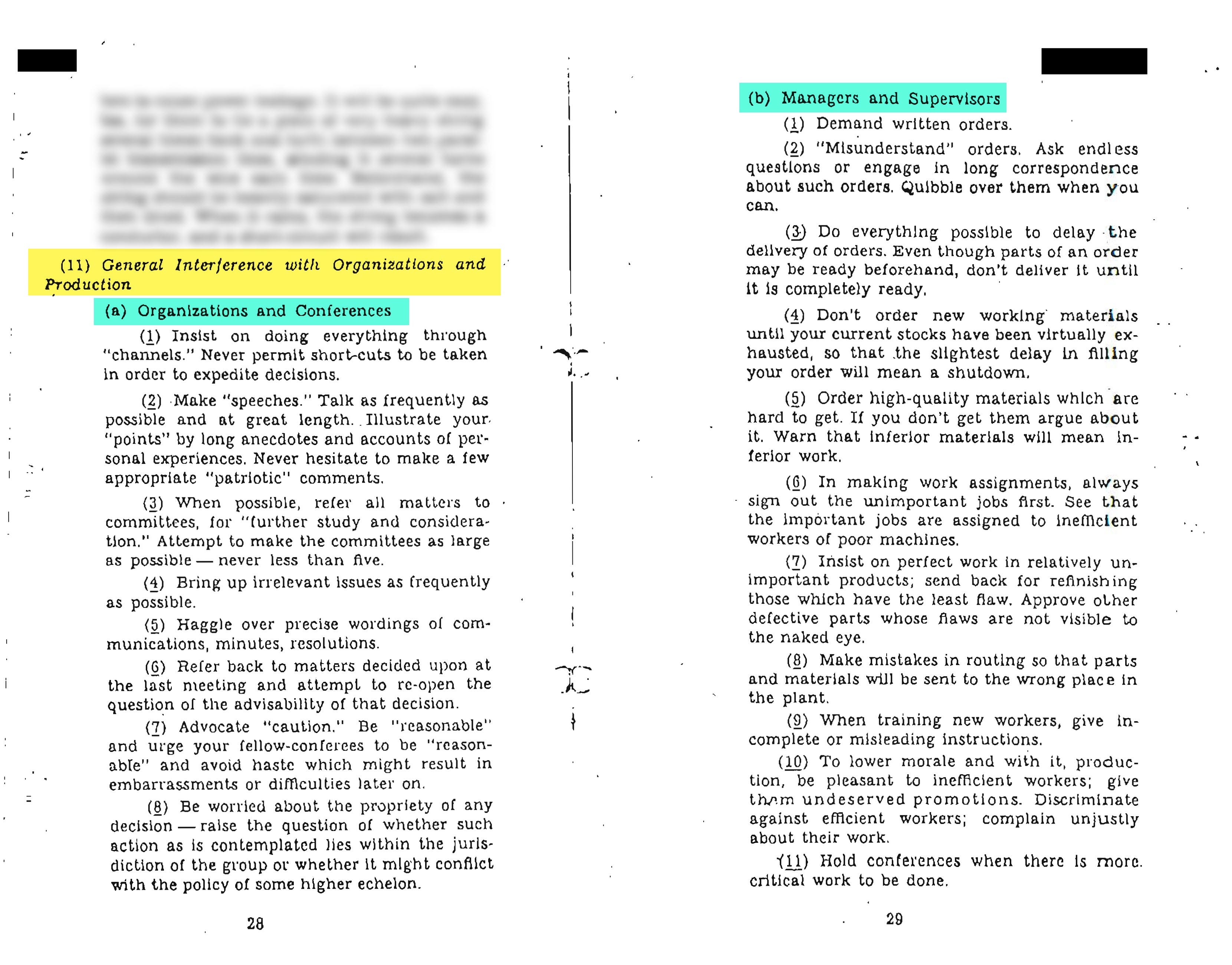
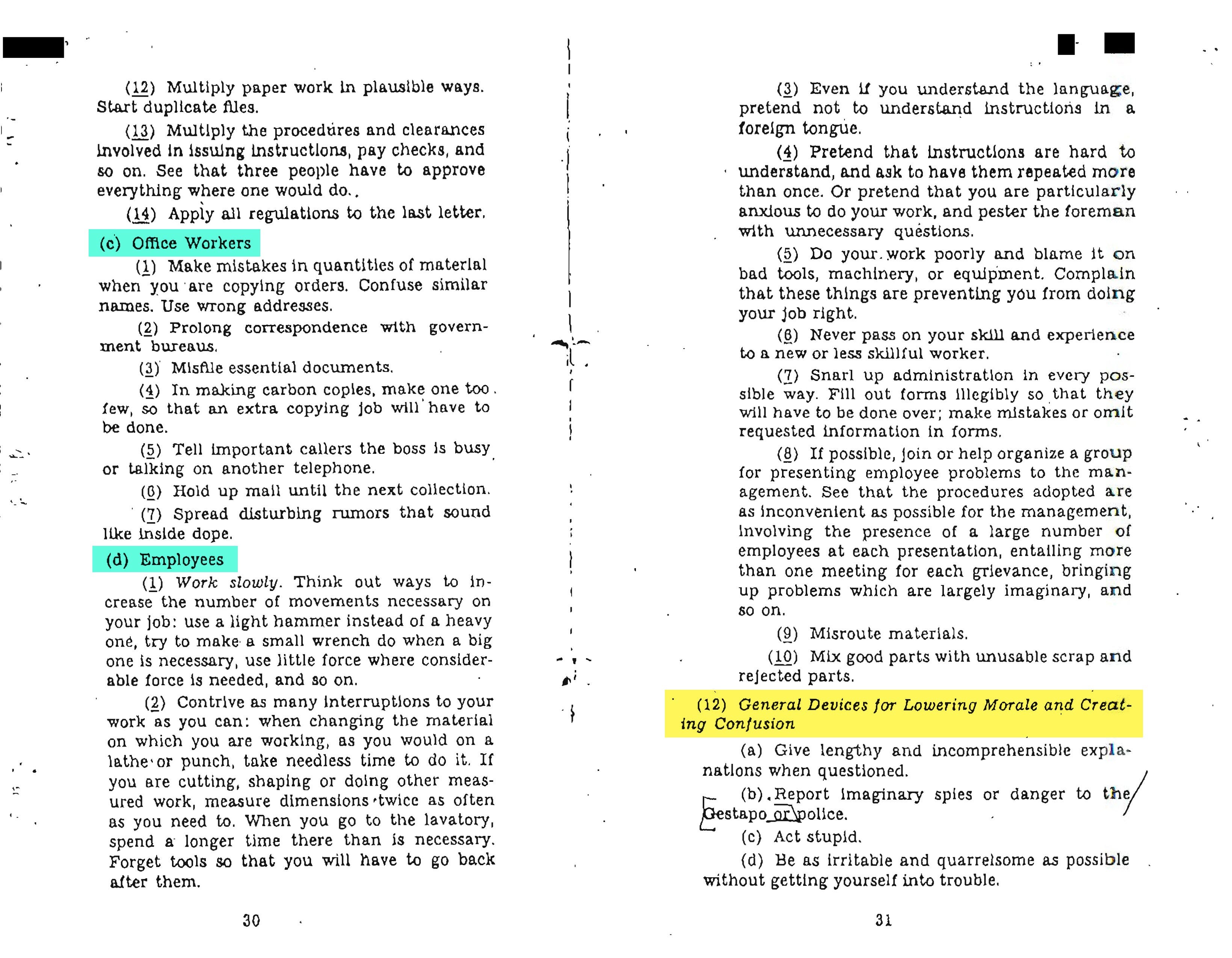
That someone is none other than the Central Intelligence Agency (CIA). Their document is called Simple Sabotage Field Manual, originally published in 1944, and declassified in 2008. The booklet contains instructions for destabilizing or reducing progress and productivity by ordinary and non-violent means, so as to minimize unnecessary attention. It was used by saboteur-recruits, most often U.S. sympathizers, who were keen to disrupt war efforts against the U.S. during World War Two.
This masterpiece of only 32 pages is separated into headings that correspond to specific audiences, including “Managers and Supervisors”, “Employees”, “Organizations and Conferences”, “Communications”, “Transportation” (Railways, Automotive, and Water), “General Devices for Lowering Morale and Creating Confusion”, and “Electric Power.”
Below are some of the most notable extracts that pertain to any type of organization:

🛠 Destroying vs. Creating
Now that you have read through the CIA instructions, I ask you: How often have you seen this same behavior in reality? Way too often, right?
It is far easier and much faster to destroy something (or someone) than to build it (them) up. Not that this needed any proof, but I did prove it with a 9,000-piece puzzle I built in 2017. It took me 2 years to finish it, and only 20 minutes to destroy it! And that tells you all you need to know about life 🙄


Therefore, if someone decides to deliberately sabotage an organization, there’s unfortunately very little we can do about it. Leadership is based on the premise that both the leader and their team have the same objective. But with deliberate (or even undeliberate) sabotage, that is not the case.
The only thing that can be done is to:
detect this behavior as early as possible, so that
we can remove that person from their position or, even better, from the organization.
And acting fast, before the “disease” spreads, is of utmost importance.
🔎 Radical Transparency
To detect unwanted behavior as early as possible and address it accordingly, we need to create an environment where:
everyone can see at any time what’s going on, and
is not afraid to take action.
A radically transparent environment checks both of these boxes. It enables everyone to see through the whole organization. And it increases psychological safety so that we won’t shy away from speaking up or tackling thorny problems.
Why is radical transparency so effective?
Because when someone hides something from us, we assume they do bad things (to us or in general). And very often that is exactly the case.
The opposite is true as well: When someone shares information with us, we assume they have nothing to hide; their conscience is clear. And that is also very often the case.
Therefore, in traditional organizations (which are not transparent), we tend to act under the impression that we’re being used and abused, even if that’s not true. Whereas in radically transparent organizations, we assume there’s no foul play, even if there is (but it’ll be harder to hide it 😉).
How do we achieve radical transparency in our organization?
By implementing some or all (and more!) of the below points.
Note: Many of the aspects outlined below are inherent to already established methodologies, such as Agile. When integrated with structural changes, they become ingrained within the fabric of the organizational culture.

1️⃣ Transparent Information
Traditional organizations share information (incl. reasons behind decision-making) on a need-to-know basis. The majority of the information is closed to us by default until we request access. And then someone has to review and approve our request (based on unclear and highly subjective approval criteria).
Radically transparent organizations, however, have the opposite logic: Everything is open to everyone by default because nobody knows or can accurately predict what information an employee might need at any given moment. And a lot of the company information is shared with the customers too. Hence, additional approval processes with dubious criteria are not necessary.
Examples: Buurtzorg, foryouandyourcustomers, Patagonia, Semco
2️⃣ Transparent Financials
In addition to pt.1, radically transparent organizations also reveal all their financial information. However, they go a step further and financially educate their employees. Otherwise, there would be no point in giving someone a text written in a language they can’t understand.
Examples: Choose a case study.
3️⃣ Transparent Value
In radically transparent organizations, employees are well aware of the value they bring to their customers. This is achieved by closing the feedback loop, i.e. receiving direct feedback from the customers of their work.
One way to do this is by e.g. Software Developers also acting as Customer Support for their software products. Another way is to base employee’s salaries on customer value/feedback.
4️⃣ Transparent Deliverables
In radically transparent organizations employees commit to each other on their future deliverables and hold each other accountable. Work is visualized and it’s always clear who works on what and where they’re at. There’s no need for a manager or a supervisor to oversee and coordinate all of this.
Examples: 37signals, FAVI, Morning Star, Valve
5️⃣ Transparent Performance
In radically transparent organizations everyone's performance is clear to everyone else. Employees either assess each other, or get feedback from their coach, or teams compete on a company-wide leaderboard (i.e. the process is gamified), etc.
Examples: Cocoon Pro, Buurtzorg & Handelsbanken, Happy
6️⃣ Transparent Improvements
In radically transparent organizations everyone can bring any matter for discussion. Employees don’t have to come up with solutions before approaching their managers with a problem. And managers don’t try to avoid uncomfortable topics. Hence, improving the organization and the ways of working supersedes individual issues.
Examples: BrewDog, Futurice, Heiligenfeld, UKTV
7️⃣ Transparent Compensation
In radically transparent organizations employees get to know, and even set each other’s salaries. The latter is either directly based on job performance (as per pt.5), or carried out as a separate process.
Even though this might be the most radical idea on the list, it’s the one that establishes a sense of fairness the most. Evidently, we are not at all unreasonable with our salary expectations. And in the rare cases that we are, our colleagues will equalize them, as per the process.
Examples: Cocoon Pro, Happy, HolacracyOne, Morning Star, Semco, Valve
And that’s how we convert organizations into open, fair, trustworthy, and psychologically safe environments. And in doing so, we also empower employees to bring their best selves to work.

Thank you for reading 💝
Till next time,
Irina