


Imagine you’re attending the company all-hands meeting and your CEO starts with the following speech:
“I gathered you today to reinforce the message that we're here to fight back. We aim to defend our position in the market and capture an even larger slice. Therefore, we have to attack the opposition. To win this battle, and ultimately the war, we need a strategy for disruption. Being on the defensive is not an option. Sometimes, aggressive moves are required…”
Have you realized that you participate in war? Because, sadly, business is approached the same way as war.
But it doesn’t have to be that way.
Read on 👇
🥤 Cola Wars
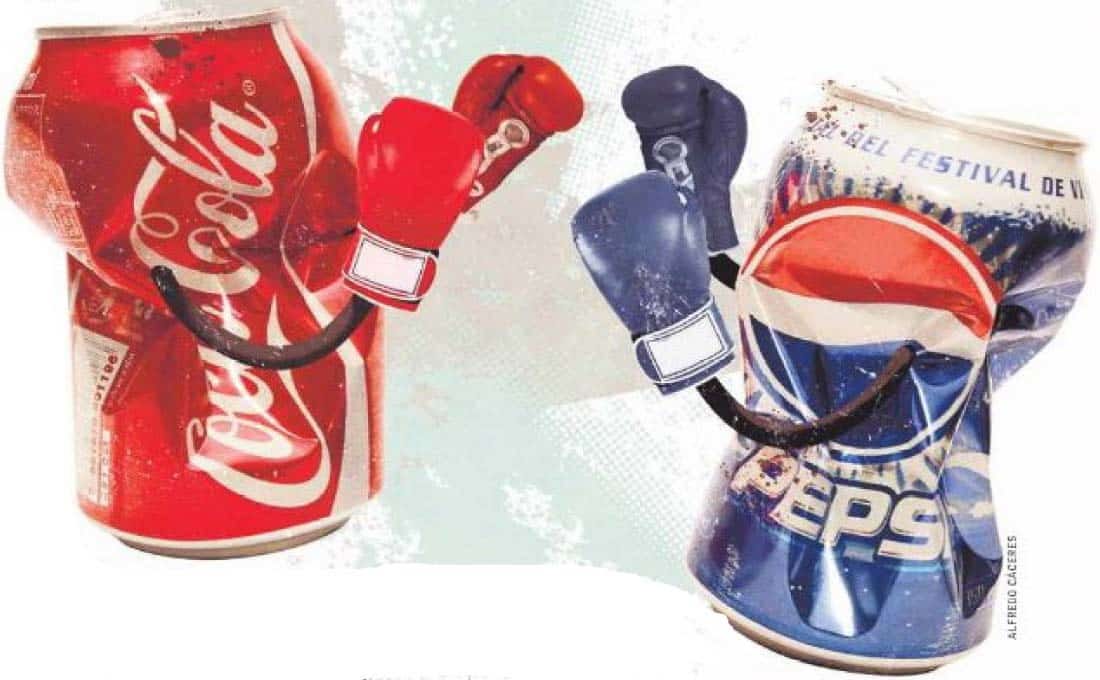
In 1886, John Stith Pemberton, a pharmacist from Atlanta, Georgia, developed the original recipe for Coca-Cola. By 1888, the recipe was acquired by Asa Griggs Candler, an American businessman and politician, who founded The Coca-Cola Company in 1896.
Meanwhile, in 1893, another pharmacist, Caleb Bradham, from New Bern, North Carolina, created the Pepsi drink. Originally, he called it “Brad's Drink” and renamed it to Pepsi-Cola in 1898. In 1902 he founded The Pepsi-Cola Company, thus prompting the beginning of the “cola wars”.
Coca-Cola has seen remarkable growth since its inception, now distributing close to 4.5 billion cases annually across its nearly 400 brands in over 200 countries. Holding a dominant 44% market share globally, Coca-Cola's flagship product, Coca-Cola Classic, remains the world's most popular beverage. With a robust R&D program and strategic acquisitions, Coca-Cola has diversified its product line to include many different drinks. In 2003, the company allocated approximately $1.9 billion to marketing and advertising, with plans for further investment.
Pepsi-Cola has historically positioned itself as the strongest competitor of Coca-Cola, establishing an extensive franchise bottling network and broadening its product range through acquisitions. With a market share of 31.8% and annual sales of 3.2 billion cases in 2003, Pepsi-Cola holds the second-largest share in the soft drink industry. Embracing a “Beat Coke!” mentality since the 1950s, Pepsi continues to invest significantly in marketing and advertising, allocating $1.6 billion in 2003 to reinforce its competitive stance against Coca-Cola.
The rivalry between the two soft drink producers has been fierce. With the industry's annual retail value in the U.S. reaching $65 billion, and “cola” flavors representing nearly 70% of market share, the stakes are high. Both companies continuously innovate and introduce new products, engage in strategic marketing, and even compete in product packaging to gain an edge over each other in this ongoing battle for industry dominance.
Their mutually-targeted marketing campaigns have been especially entertaining for the general public. Some memorable battles that deserve mention include:
⚖️ In 1975, Pepsi started running the so-called “Pepsi Challenge.” It involved participants doing blind taste tests between Pepsi and Coca-Cola, with Pepsi being chosen as the winner. Coca-Cola thus ran its own taste tests, only to confirm that many participants, including possibly some Coca-Cola executives, indeed preferred Pepsi.
🧪 In response to the “Pepsi Challenge,” Coca-Cola started playing with the formula and in 1985 introduced its “New Coke.” However, due to consumer backlash, it had to return to its original formula under the name of “Coca-Cola Classic.” Pepsi didn’t miss the chance to capitalize on the situation with ads poking fun at Coca-Cola's misstep.
🛩 In 1995, the “Pepsi Stuff” promotion featured a humorous ad where one could supposedly redeem 7 million Pepsi Points for a Harrier Jet. That led to an unexpected legal dispute when a young man tried to claim the jet, arguing the commercial was a binding contract. In 2022, Netflix premiered its original docuseries, “Pepsi, Where's My Jet,” describing the event.
🍕 During the Academy Awards in 2014, despite Pepsi being the exclusive soft drink sponsor, Coca-Cola unexpectedly gained exposure when its logos appeared on pizza boxes featured in a comedic bit by host Ellen DeGeneres. Coca-Cola's unplanned placement during the high-profile event sparked attention, speculation, and concerns, with television network ABC having to investigate the incident.

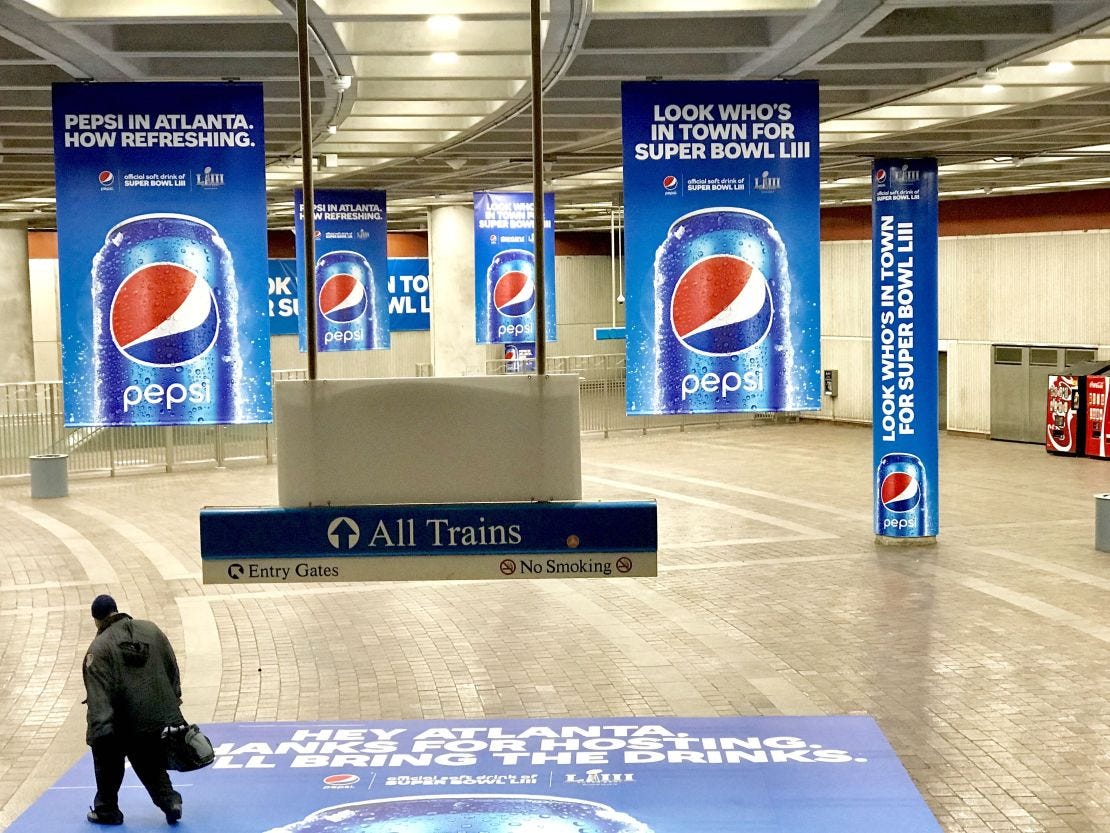
🏉 In 2019, during Super Bowl LIII held in Atlanta, Coca-Cola's hometown, Pepsi, being a major sponsor of the NFL for years, capitalized on the situation with advertising slogans like “Pepsi in Atlanta. How Refreshing,” “Hey Atlanta, Thanks For Hosting. We'll Bring The Drinks,” and “Look Who's in Town for Super Bowl LIII.” Both companies aired TV ads during the game, with the tagline “A Coke is a Coke” by Coca-Cola and “Is Pepsi OK?” by Pepsi.
For more details on Coca-Cola vs. Pepsi, check out the Business Wars podcast.
⚔️ “Business Is War”
The concept of management originated in ancient China with centralized bureaucratic states and merit-based administration. Ancient military texts provided the lessons needed for civilian managers. For example, Chinese general Sun Tzu in his 6th-century BC work “The Art of War” recommends being aware of and acting on the strengths and weaknesses of both a manager's organization and a foe's.
Throughout history, structured management systems were evident in the Roman military hierarchy, the Roman Catholic Church's organization, and medieval guilds, all of which had defined chains of command and authority.
Military and management have always been closely intertwined. Even today, the army is the first to implement new managerial concepts and frameworks. Once these ideas are tested and proven in practice, they are adopted by the corporate world as well.
As a result, our modern-day executives still take business advice from the military. Books such as Sun Tzu’s “The Art of War”, Clausewitz’s “On War”, Machiavelli’s “The Prince”, Musashi’s “A Book of Five Rings”, Greene’s “48 Laws of Power”, Matthews’ “Hardball”, and many more are extremely popular business literature.
The concept that “business is war” permeates all of our culture. In addition to books, we hear it amplified by famous business people, we see it in movies, we listen to it in podcasts, there are even computer games about it.
Therefore, it’s no surprise that we use the language of war when we refer to business:
Our competitors are our opponents; we attack them and defend ourselves.
We fight battles and try to kill our competition to save our business.
We steal market territory and win, conquer, or expand to new markets.
We save or lose resources: money, people, time, effort, etc.
We execute plans, strategies, campaigns.
We use marketing tactics such as guerilla marketing, ambush marketing, stealth marketing, or hijacking social events.
We engage in industrial espionage and sabotage organizations.
Our management style is command-and-control.
Chief XYZ Officers or Heads of XYZ, who are in charge, give orders; people in the field execute them.
We stand our ground, stick to our guns, or march to the beat of our own drums.
We cut down task force.
Etc.

💣 Why the War Metaphor Is Bad
In the book “Metaphors We Live By” (which I highly recommend!), the authors, George Lakoff and Mark Johnson, state the following:
“The concepts that govern our thought are not just matters of the intellect. They also govern our everyday functioning, down to the most mundane details. Our concepts structure what we perceive, how we get around in the world, and how we relate to other people. Our conceptual system thus plays a central role in defining our everyday realities.”
When we’re at war, our main personal objective is survival. And when we are put in survival mode, everything we do is warranted. “The end justifies the means”, as the saying goes.
In business, survival means profit. Therefore, when we’re in a perpetual-crisis and survival-at-all-costs mode, all we can think about is making money. To that end, our moral compass completely disappears and we can justify even the most awful behavior:
breaking rules and laws, corrupting officials,
causing environmental disasters,
harming the local communities,
abusing our employees or colleagues,
treating everyone as the enemy (including ourselves),
disregarding our promises, principles, and values,
and much, much more.
But here’s the catch: When we focus only on the similarities between business and war, we completely overlook the differences.
While war is about destruction, business is about creation.
While our goal in war is survival, our goal in business is to make a positive change in the world with our product or service.
While in war we look for ways to defeat our enemies, in business we look for ways to make our product or service better.
While in war risks and experiments must be avoided so we don’t die, in business risks and experiments must be taken so we can learn and improve.
While war is a zero-sum game (i.e. others have to lose so we can win), in business the market is open to everyone.
While in war soldiers are discouraged from objecting to orders, in business employees are encouraged to voice their opinions.
While war is inherently male, business embraces diversity.
While in war we can’t trust anybody, we do business with people whom we trust.
And so on…
💞 Time for a Change
Business is long overdue for a makeover. There are plenty of better-suiting metaphors out there than war: Business can be art or science, gardening or hiking, playing games or nurturing relationships, love or creation, passion or devotion.

When our driving force becomes love, light, and creation, instead of war, darkness, and destruction, we shift our focus from:
money to purpose,
survival to improvement,
threats to opportunities,
fear to trust,
fighting to collaborating,
our competitors to our organization,
our own needs to the value we bring to others,
control and command to distributed leadership,
discrimination to diversity, equity, and inclusion,
etc.
And while we might think that we need a mindset shift in order to change our language, the opposite is just as true - we can shift our mindset by first changing our language. We know that we’re affected by the words we use - even plants are.
Therefore, we can start by excluding “war” references from our business vocabulary and substituting them with more positive associations. Here’s a suggestion:
❌ Words to Avoid
aggressive, alliance, ally, ambush, attack, armament, arms, army, artillery, battle, battlefield, bloodshed, campaign, capture, combat, command, command-and-control, competition, conflict, conquer, conquest, defeat, defend, defensive, demolition, destruction, disarm, disruption, enemy, espionage, fight, fighter, fighting, forces, frontline, guerilla, guns, hijack, hostile, invade, in charge, in the action, invasion, kill, leadership, mission, munition, on the field, opposition, ranks, reconnaissance, reinforce, resources, sabotage, siege, soldier, spy, steal, stealth, strategy, struggle, tactic, target, trenches, troops, victory, war, warfare, warrior
✅ Words to Use Instead
adapt, align, appreciate, attract, balance, bond, build, care, cherish, collaborate, commit, communicate, compassion, compose, concept, conceptualize, connect, construct, conversation, cooperate, craft, craftsmanship, creative, desire, design, develop, devotion, embrace, emotion, empathy, engage, fond of, formulate, fulfillment, generate, harmony, ideate, imagination, improvement, include, influence, initiate, inspire, integrity, invent, loyalty, mastery, model, motivate, nurture, originate, partner, partnership, passion, produce, promise, recognition, refinement, relationship, reliability, respect, satisfaction, support, synergy, synthesize, team, teamwork, transformation, trust, trustworthiness, unity, value, vision, warmth
It’s a completely different feeling only reading through these two lists, isn’t it? 😉
”Words have a way of creating their own imperatives.” - Stephen King
And that’s how we use the power of language to begin thinking and acting in a better way. And by doing so, we also create a more positive environment for ourselves and everyone around us.

Thank you for reading 💝
Till next time,
Irina